Request revenue calculation

Your emergency power generator as a source of revenue

Earning money with decentralized feed-in tariffs and balancing energy marketing

In most cases, emergency power generators are not used apart from trial operation and thus only cause costs. However, the plants can cover much more than just a very rare grid failure: With RWE's support, you can use your emergency power plants to reduce your operating costs and even generate additional revenue.

On the one hand, this is done by using your gensets for the provision of positive balancing reserve or positive balancing energy.

However, RWE goes beyond this approach, which is widespread on the market, and is the only provider able to open up two additional sources of revenue for your company with the decentralized feed-in tariff (DZE) and peak load shaving. As a result, revenues are usually much higher than those generated by pure balancing energy marketing.

At the same time, the targeted use of your gensets for only a few hours a year relieves the power grid and thus helps to advance the energy transformation in Germany. With all these advantages, the original function of your genset, the supply of emergency power, remains unaffected.


Balancing energy, DZE & Co: Your revenue sources in detail

By having your emergency power generator operated for just a few hours in a year, you can turn the power of your genset into cash.

And because RWE, as one of the leading energy suppliers in Europe, offers you significantly more options for this than most competitors, you can from each option with our various product modules!

Find out more about our product modules by clicking on the corresponding plus sign.

Revenue sources in detail
An infographic illustrating energy services with icons for decentralised feed-in tariff, balance energy, and peak load shaving.

Decentralized Feed-In-Tariff

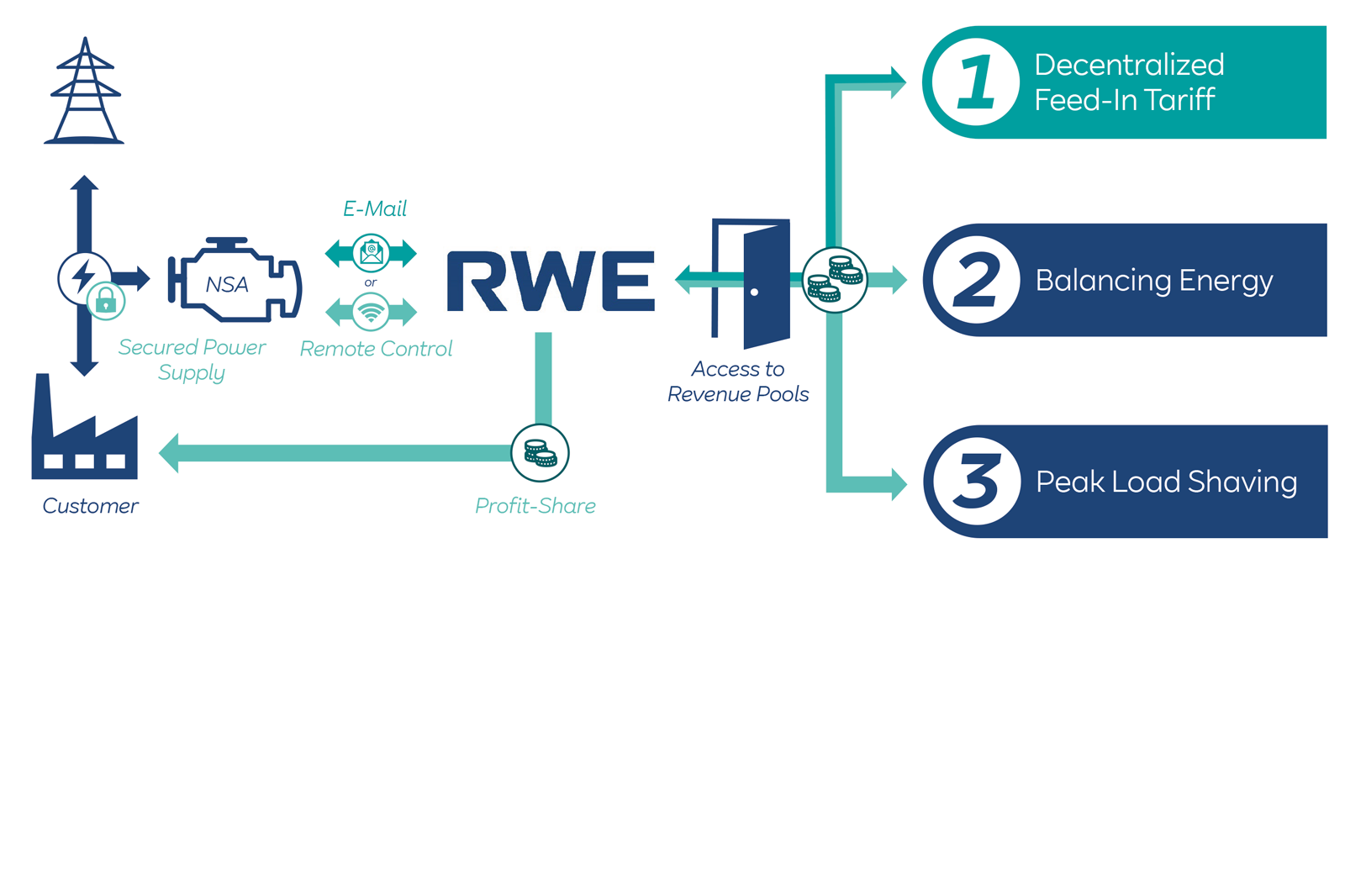
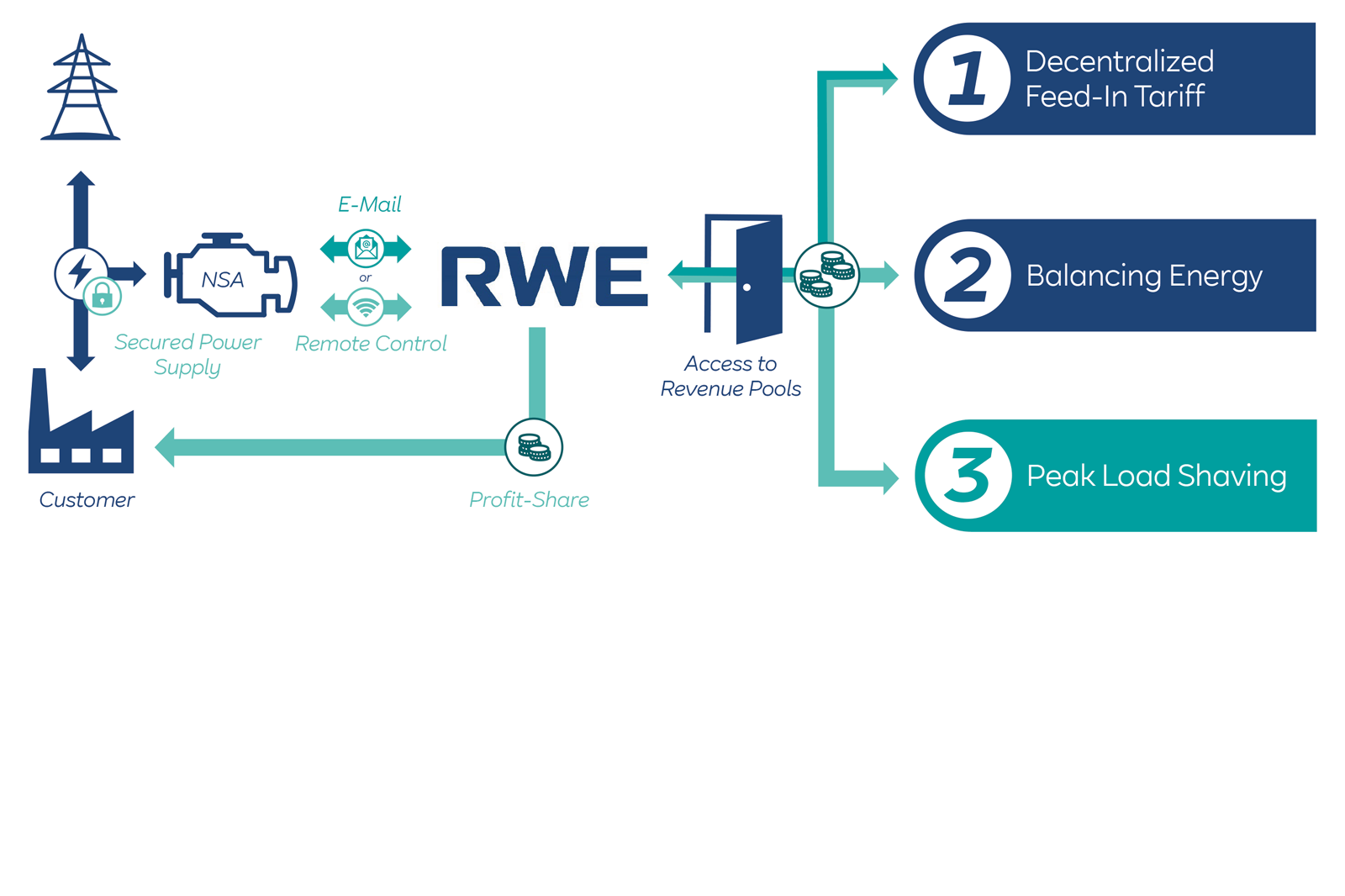
On the one hand, your emergency generator can be used to relieve the load on the power distribution grid by means of decentralized feed-in. This means that the trial operation of your emergency power system is optimized by RWE so that it takes place at times when the power grid is under particularly heavy load.

In addition to the economic benefits for the society, this marketing can generate attractive revenues, the so-called decentralized feed-in tariff (DZE), for avoided grid usage. This is paid out by the upstream network operator if the genset has fed in at the time of the annual peak load. This is exactly the quarter of an hour in which the grid had its absolute load peak of the respective calendar year.

However, this one quarter of an hour of the year is not fixed in advance. This is where RWE's many years of expertise in the marketing of power plants and the load forecasting model developed specifically for this purpose come into play. Tried and tested many times, RWE's optimization algorithm is able to predict the time of the annual peak load with a high degree of accuracy after the model has been customized especially for you.

The revenues generated in this way are particularly attractive. Experience shows that very few operating hours per year are sufficient for this. We can inform you of the right times for this optimized operation by e-mail or control the plants directly from a distance - just as you wish.

Diagram illustrating RWE's energy solutions, including feed-in tariff, energy balancing, and peak load shaving.

Balancing energy marketing

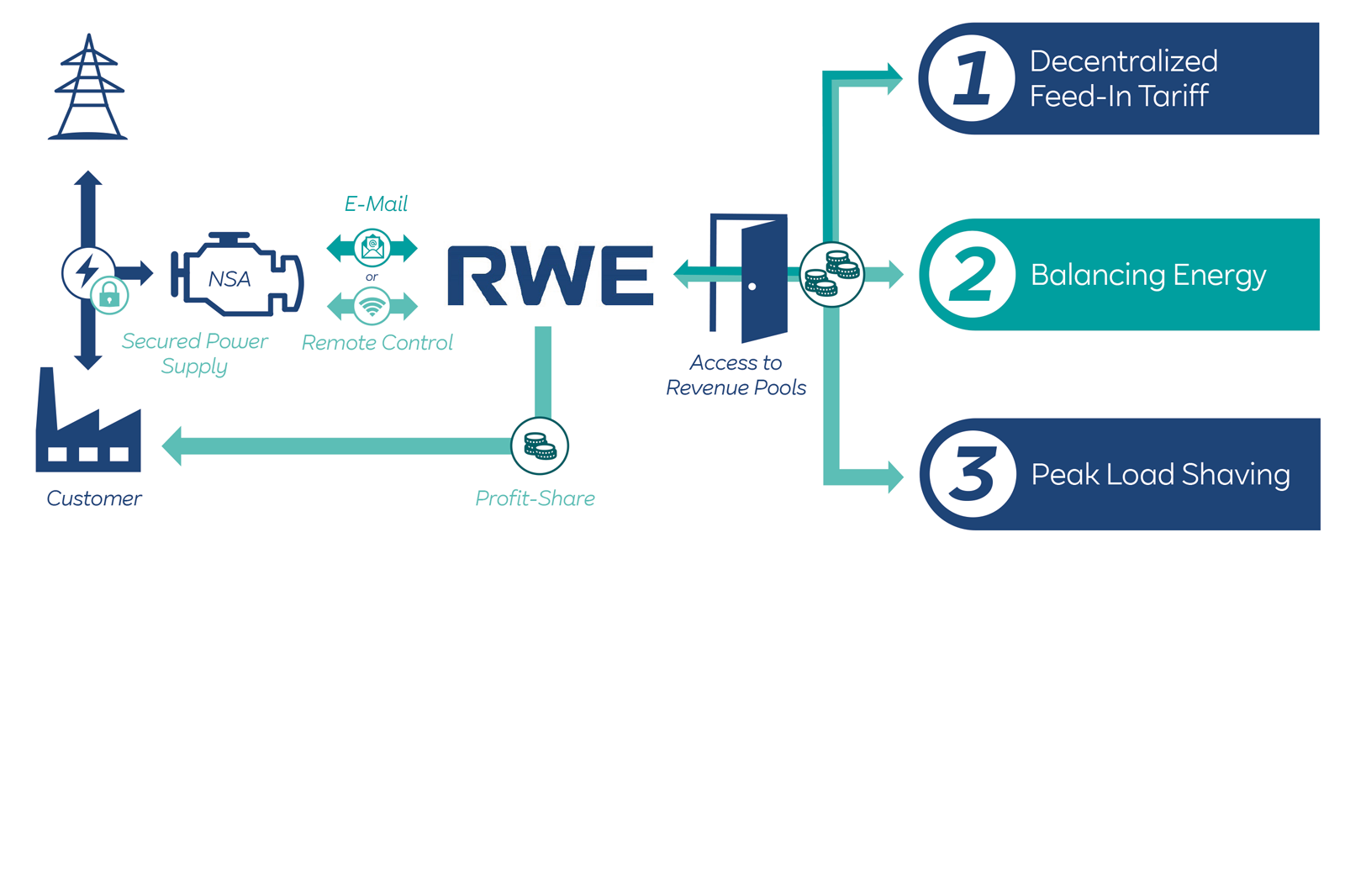
Your emergency generator can contribute to the stabilization (frequency maintenance) of the public power transmission grid. This is done by marketing balancing energy.

For marketing purposes, the "RWE Flex2Market Box" is a tried-and-tested, secure remote control technology that RWE can use to optimally deploy your plants via remote access.

Your gensets are kept in reserve to ramp up power generation and support the grid in the event of an emergency. Since the plants are kept at operating temperature anyway for grid replacement, they are ideally suited for maintaining this positive balancing reserve. The mere provision of this power generation capacity as positive balancing reserve is already remunerated.

If an emergency should occur, the genset is started up within a short time and provides balancing power. However, in view of the large pool of generators in RWE's portfolio that are capable of providing balancing power, an actual call-up of your genset is extremely rare. In this way, you benefit from the remuneration for the provision of balancing power, but hardly have to accept any additional operating hours for your genset.

An infographic illustrating energy management processes involving RWE, highlighting customer engagement and revenue access.

Peak load shaving

By selectively deploying your genset, peak load shaving can significantly reduce the cost of your electricity purchases from the public grid.

RWE analyzes your individual power load profile and develops application models that offer the greatest possible added value for your company. The goal can either be to simply reduce the peak load drawn from the power grid by the output of your emergency generator.

In many cases, however, it is also possible to use your emergency power plant to change your electricity consumption in such a way that special forms of grid usage can be obtained. By means of these individual grid charges, up to 90% of your grid charges can be saved via so-called intensive grid usage for uniform power purchase profiles. Or via so-called atypical grid usage, where you only have to pay the power charge for the maximum power drawn during high-load time windows.

RWE will check for your individual case to what extent even significantly higher savings can be realized for your company.

An infographic showing energy management processes including secured power supply, customer profit-sharing, and RWE access.

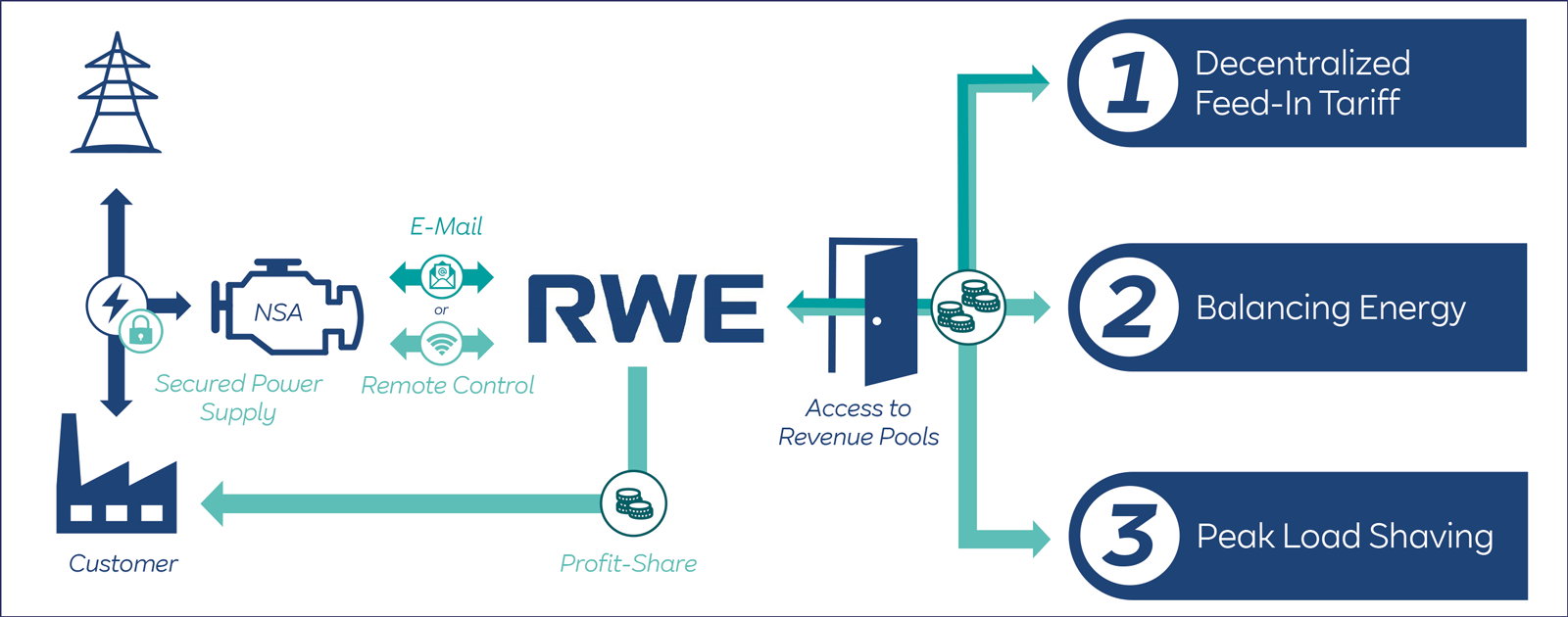
The figure shows the schematic of the RWE optimization concept for emergency gensets (incl. emergency power function, control options, profit sharing and product modules).

Your benefits at a glance

RWE Image
Economic advantages

Economic advantages

As one of the leading energy suppliers in Europe, RWE can tap into significantly more sources of revenue than its competitors - with just a few uses of your emergency power generator. You and RWE share the costs, especially for upgrading and fuel, as well as the subsequent revenues according to a fair and transparent profit-share model, whereby both partners pursue a common goal.

RWE Image
Technical advantages

Technical advantages

The infrequent use of your emergency power generator for grid services replaces the test runs that are necessary anyway and avoids the risk of damage to the grid by operating at full load "Wet stacking" and the associated system failures. The original function of your emergency power generator remains 100% intact and is maximally accelerated by RWE's access.

RWE Image
Organisational advantages

Organisational advantages

RWE examines the individual technical and licensing conditions and develops a customised concept to utilise the output of your emergency power generator as profitably as possible. During "optimised trial operation", all requirements and regulations for the use of emergency power generators and in particular their operating times are complied with. Your individual restrictions can also be taken into account. In addition, the optimisation enables regulatory-compliant billing.

RWE Image
Ecological advantages

Ecological advantages

The optimised trial operation of your emergency power generators provides a resource-efficient grid service. The use of the regeneratively produced fuel "HVO 100" can also reduce CO2 emissions by up to 90%; additional costs can be refinanced via the proceeds. By purchasing voluntary emission reduction (VER) certificates, the operation of the gensets can also be made completely climate-neutral if required.


Our approach

We see our service as a full service offer. This includes all project steps from professional initial consultation to optimized deployment. In this way, your effort is kept to a minimum.

Careful testing

Together with you, we check which technical and permit-related boundary conditions have to be taken into account in your individual case. Against this background, we develop a concept tailored to your needs that shows you the optimal options for using the capacity of your emergency power generator as profitably as possible without adversely changing the existing boundary conditions.

Reliable plant Control

You decide whether remote control technology is desired or not. In contrast to peak load shaving and balancing energy marketing, decentralized feed-in can also be implemented without remote control technology.

If you should also be interested in the other modules, we will install a proven and reliable remote control technology in coordination with your plant manufacturer or maintenance service provider. In all cases, the priority circuit for emergency power use remains untouched, of course, so that the primary function of the emergency power supply remains unchanged.


FAQ

  • This is not considered additional operation. The grid-supporting services are provided as part of the test operation. It is therefore an optimized test operation that is scheduled and made more flexible. This way, the required annual test operation is fulfilled while simultaneously generating an additional source of revenue.

  • Yes, even when the generator is used for grid-supporting purposes, its primary function – emergency power supply in the event of a public grid failure—remains unchanged. In the event of such an emergency, RWE has no further access to the generator. TÜV Nord confirms its reliability.

  • No, your generator does not become a power generation plant when used within the permissible scope of test operation. According to relevant regulations, emergency generators are not considered power generation plants even when used for grid-supporting purposes, as long as the usage remains within legal limits (maximum 15 hours per month or 300 hours per year, if specified in the permit).

  • No, the actual operating times for the respective product modules are relatively low:

    • Decentralized Feed-in Compensation (DZE): < 25 hours per year
    • Peak Load Reduction (SLK): < 10 hours per year
    • Marketing of Control Reserve – Secondary Control Reserve (SRL): < 10 hours per year

    Especially for “SRL,” the focus is on capacity provision. The mere availability of the system for potential activation is compensated with a capacity price.

  • Deviating from the technical connection rules (TAR 4110), which limit test operation of emergency generators to one hour per month, the operating limits for parallel grid operation can be extended in coordination with the distribution network operator. According to permit regulations, up to 15 hours per month or 300 hours per year are allowed for test operation.

  • No, RWE does not charge any service fees. We work with a profit-sharing model in which both costs and revenues are shared in partnership.

  • To participate in the project, a minimum total capacity of 1 MW per site is required. Additionally, to qualify for DZE compensation under § 18 (1) StromNEV, the generators used must have been commissioned before January 1, 2023.

  • No. Typically, the generators are used for one hour per month, i.e., 12 hours per year, for the intended test operation. RWE anticipates a maximum annual usage of 50 hours. Maintenance cycles are only affected if the runtime exceeds 300 hours per year.

  • To provide grid-supporting services, your generators must be capable of feeding into the grid and therefore must be operated in parallel with the grid.

    This requires approval from your upstream network operator, which we will obtain together in a joint meeting.

  • No, modern emergency generators are equipped with intelligent fuel management systems. Defined fuel limits and automatic shutdown systems ensure safe operation. Even at critical fuel levels, automated monitoring intervenes. In practice, the systems usually run for only a few minutes. This means: maximum efficiency with minimal consumption.

  • Absolutely. As part of critical infrastructure, the operation is subject to the highest cybersecurity standards. As Germany’s largest power plant operator, we rely on certified security architectures, encrypted data communication, and regular penetration tests. The systems are fully integrated into the existing IT security strategy and meet all BSI requirements and are certified according to DIN EN ISO/IEC 27001.

  • No, increased wear is not expected. Targeted load management strategies prevent so-called wet-stacking (incomplete combustion at partial load). In addition, a TÜV report confirms the technical safety. Maintenance intervals remain unchanged, ensuring the economic efficiency and longevity of the systems.

  • Yes, absolutely! If you have generation systems, battery storage, or controllable consumers whose flexibility you would like to market and optimize on the control reserve or intraday market, we have just the right solution for you: take a look at the D-Central product from our colleagues at RWE Supply & Trading.

    D-Central offers you an intelligent platform for bundling and marketing decentralized flexibilities—whether industrial loads, storage systems, or other controllable assets. More information is available here:


Our references

We are already successfully marketing emergency power generators with the following partners:


Request revenue calculation

1
Your asset
2
Your contact details
3
Your message to us

* Mandatory fields

Further information on data protection can be found in our privacy policy.

Enter your contact details in the next step.

Claudius Beermann

Commercial Asset Management

RWE Supply & Trading GmbH

Philipp Kremer

Commercial Asset Management

RWE Supply & Trading GmbH

Mike Mitulla

Commercial Asset Management

RWE Supply & Trading GmbH

RWE Platz 6 45141 Essen

More offers of RWE Supply & Trading

D-Central

With D-Central, RWE Supply & Trading offers you the opportunity to market your power generation plants and controllable consumers on flexibility markets.

D-Central

EEG direct marketing

For operators of a renewable generation asset or a cross-technology generation portfolio, RWE Supply & Trading offers the direct marketing for you.

Read more

ECT – Easy Commodity Trader

ECT offers you a professional environment for trading with various commodities.

ECT